Sunday, March 24, 2013

John Brooks and Philadelphia

Before visiting last week, I had been in Philadelphia only twice before, and that was when the Presidents were Ford and Carter. So I'm not qualified to call it Philly. Stlll, the people and places felt familiar. I took full advantage of the $11 Independence Pass, which provides all-day riding on the SEPTA transit system.
Information on Brooks families compiled in folders at the Historical Society of Pennsylvania revealed no connection to my ancestor. Probably he would belong to one of the "no more is known about this branch of the family" branches in one of their folders.
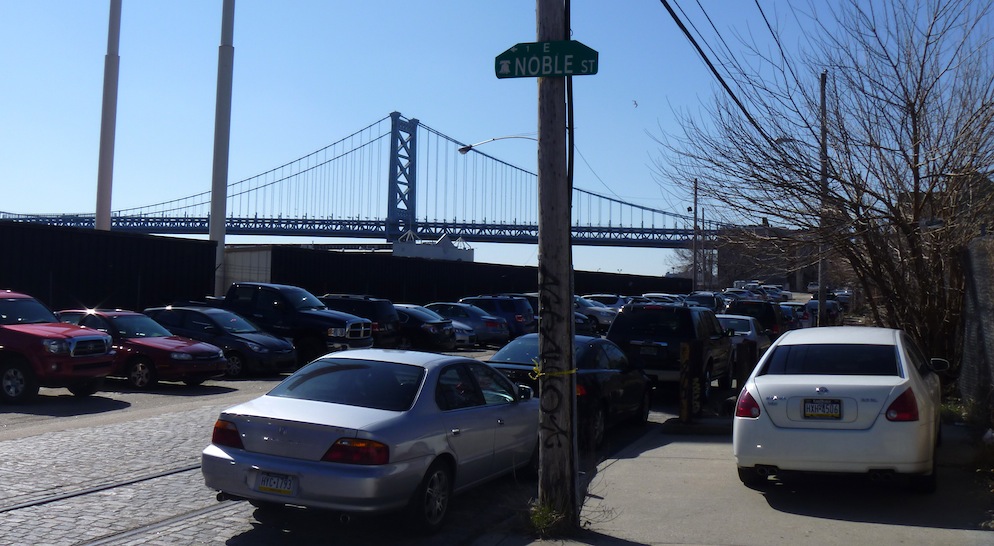
One thing that did catch my eye was in the HSP collection of Philadelphia City Directories. The 1833 directory lists a Lewis Brooks, Blacksmith, at 54 Noble St. His name had been spelled Brooke in 1825. He does not appear in the 1835 directory. The picture above documents my pilgrimage to the intersection of Noble and Front Streets, located in the Northern Liberties section of Philadelphia, on the Delaware River side of I-95, just around the corner from the Spring Garden station on the Market-Frankford line. The Ben Franklin Bridge spans the distant skyline. The street sign with an arrow pointing left indicates that the present-day numbering begins at Front Street. (I-95 obliterated whatever portion of Noble may have once extended to the right.) I imagine that back in 1833 a low street number like 54 would have been located nearby.
Of all the theories I've considered about what the L.W. may have stood for in John L. W. Brooks, the simplest is that it stands for Lewis, especially if one were to emphasize the two syllables in pronouncing the name. The 1820 census for Northern Liberties has a George Brooks, which would fit the traditional naming pattern for John(Lewis)'s oldest son. On the other hand, the maternal grandfather was George, and he may have been the namesake. It isn't much to go on, but that's all I have for now. At any rate, the cobblestones/bricks make it easy to imagine this section of Front Street back around 1830.

Monday, June 18, 2012

Boundaries of some Greek-Catholic Parishes in Old Hungary

This post is limited to the area around the triple-point where present-day Hungary, Slovakia and Ukraine meet. The scale of the map below is approximately 50 km horizontally from western to eastern edge. The dashed lines are present-day international borders (shown only where they do not overlap with the old parish borders). The wavy/scalloped line is the Tisza River. It flows from east to west, reaching its northernmost point near the middle of the map. For the most part, parishes do not cross the Tisza. The one exception is parish No. 25. In 1920 part of the northern border of Hungary was placed along the northernmost segment of the Tisza. The remainder of the northern border of Hungary on this map diverges from the Tisza, off to the west and off to the southeast. The dashed line extending north from the river is a border established only after World War II. West of that line is present-day Slovakia, east of there is Ukraine.

Following are three tables listing the parishes, grouped according to the location of the parish's town namesake.

First Group: Parish town located in present-day Slovakia
No.Old NameCurrent Name and DistrictOld County and District
1Sámogy (musovce)
(includes Lasztomér)
Šamudovce, Michalovce
(separate Lastomír)
Zemplén, Nagy-Mihály
2KráskaZemplínska Široká
(Krášok), Michalovce
Ung, (Nagy)Kapos
3SólymosIňačovce, MichalovceUng, Szobráncz
4Sáros-Reviscse, SárosrőcseBlatné Revištia (te), SobranceUng, Szobráncz
5PorosztóPorostov, SobranceUng, Szobráncz
6Felső-Némethi (mete)Vyšné Nemecké, SobranceUng, Ungvár
7Korumlya (lak)Koromľa, SobranceUng, Ungvár
8FalkusFalkušovce, MichalovceZemplén, Nagy-Mihály
9Dubróka (ovka)
(includes Butka)
Dúbravka, Michalovce
(separate Budkovce)
Zemplén, Nagy-Mihály
10MárkMarkovce, MichalovceZemplén, Nagy-Mihály
11Szalók (Szlavkovce)Slavkovce, MichalovceZemplén, Nagy-Mihály
12Bező (Bezsovci)Bežovce, SobranceUng, Ungvár
13Lakárd (árt, Lekárt)Lekárovce, SobranceUng, (Nagy)Kapos
14PetrikPetrikovce, MichalovceZemplén, Nagy-Mihály
15Csicser (Csicsarovci)Čičarovce, MichalovceUng, (Nagy)Kapos
16MátyócMaťovské Vojkovce, MichalovceUng, (Nagy)Kapos
17Lelesz-Polyán (Bodrogmező)Poľany, TrebišovZemplén, Bodrogköz
18Zemplén (Zeume)Zemplín, TrebišovZemplén, Sátoraljaújhely
19Kis-DobraDobrá, TrebišovZemplén, Bodrogköz

Any of the Slovak place-names can be searched for in the familysearch.org online catalog. There you will find, in addition to information about the availability of microfilmed Greek-Catholic records for that parish, an alert that church records for Slovakia are available online. Follow that link, and you will find another link inviting you to browse [an incredibly large number of] images. That link takes you to a list of denominations, from which you can re-select Greek-Catholic. You are then presented with a list of Districts (even though the page title says Counties). Selecting a district provides a list of parishes, and from there a manageable number of images. Most of the 19 parishes in the table above are listed on the browsing pages under one of two official Districts (Sobrance or Michalovce). But there appears to be an ongoing project to transfer some of the parishes into pseudo-districts named for a nearby main town. For example, Parishes 17 and 19 are listed under Kráľovský Chlmec (Chlumec, Hungarian Királyhelmec, the main town in the Old-Hungary district of Bodrogköz). Parish 15 has recently been moved out of Michalovce and into its own Vel'ké Kapušany (Hungarian Nagy Kapos) district. Similarly, parish 13 has recently been moved into its own Užhorod district. The link for Parish 2, although still listed under Michalovce, has recently been changed to its secondary Slovak name (Krášok). Parish 16 was available recently, but has since disappeared. I emphasize that these remarks refer only to the links as they are presented at the online site.

Second Group: Parishes in present-day Hungary
No.NameOld County and District
20CsékeZemplén, Bodrogköz
21DámóczZemplén, Bodrogköz
22AgárdZemplén, Bodrogköz
23AjakSzabolcs, Kis-Várda
24Tornyos-Pálcza (Tornyas-Pálcza)Szabolcs, Tisza
25Bács-Aranyos (Bácsaranyos)Szabolcs, Tisza

Microfilm numbers for these parishes can be found in the familysearch.org online catalog.

Third Group: Parishes in present-day Ukraine
No.Old NameOld County and District
26UngvárUng, Ungvár Town
27Alsó-DomonyaUng, Ungvár
28NeviczkeUng, Ungvár
29Or (Or-Darma, Ör)Ung, (Nagy)Kapos
30MinajUng, Ungvár
31PalágyUng, (Nagy)Kapos
32KereknyeUng, (Nagy)Kapos
33SztrabicsóBereg, Munkás
34GorondBereg, Munkás
35Makkos-JánosiBereg, Tiszahát
36ÁrokUng, Ungvár
37AntalóczUng, Ungvár
38KöblérUng, Ungvár
39RadvánczUng, Ungvár
40Darócz (Ungdarócz)Ung, Ungvár
41Nagy-LázUng, Ungvár
42HorlyóUng, Ungvár
43Iglinz (Unggesztenyés)Ung, Ungvár
44Orosz-KomoróczUng, Ungvár
45LehóczUng, Ungvár
46SzerednyeUng, Ungvár
47DubrókaUng, Ungvár
48IgnéczBereg, Munkás
49Nagy-LucskaBereg, Munkás
50Uj-DávidházaBereg, Munkás
51RákosBereg, Munkás
52Ruszkócz (Nagy-Ruszkócz)Bereg, Munkás
53ZsukóBereg, Munkás
54Nagy-MogyorósBereg, Munkás
55Orlyova (Ungasfalva)Ung, Ungvár

I have just started to participate in a project intended to establish what may have been microfilmed for these Ukrainian parishes. Information about the Munkacs Records Project can be found at the rusyns group site at yahoo.

In constructing the map of the parish boundaries, I relied on the online images of the 1877 Dvorszák Gazetter from the the University of Pécs, along with the Lazarus Military Maps (ca. 1910) from the Eötvös Loránd University, and the radixhub digitized extract of the information in the 1877 Gaztteer. The only additional information content here is the geographical relationship of the parishes to each other. To determine which villages belonged to which parishes, and how the villages were related to each other and to nearby topography, those sources should be consulted.

Monday, February 20, 2012

Family Finder Results, Part I

Results are back for both me and my Mom. There is much information to digest, and I will have more posts later. For now, some initial impressions about the matches.

Aside from the obvious parent-child match, the remaining matches (44 for me, 113 for my Mom; 25 overlap) are all distant cousins, perhaps very distant. FTDNA distinguishes between distant and speculative cousins, and provides an estimate of the relationship. My early reaction is to take those distinctions with a grain of salt. Initially my focus is on the length of and the number of segments in the matches.

On the list of matches results page, there are two lengths provided for each match: (1) the sum of the lengths of all of the matching segments and (2) the length of the longest matching segment. Those lengths are reported in centiMorgan values (FTDNA FAQ 52). The Chromosome Browser page provides more detail, but for only five matches at a time. Although I have looked at those details for only a portion of the matches, a consistent pattern has emerged. In each case there are several (usually at least eight, sometimes 16 or more) matching segments. All but one of those segments fail to meet the 5 centiMorgan minimum length required by the program for a match (FTDNA FAQ 30). But there is one much longer segment, and it is because of that one long segment that a match is reported (FTDNA FAQ 30). In each case the longest block happens to be the only segment longer than 5 centiMorgan.

Besides hypothesizing with distant cousins about possible connections that we may never be able to prove, it is also interesting to look at the results collectively. For example, there are 19 of my matches that do not overlap with my Mom's. About half of those are clearly tied to Eastern Europe; certainly their connection is through my Dad's ancestors. And about half of those ties are to the parts of present-day Poland and Ukraine that were known as Galicia when they were part of the Austro-Hungarian Empire. It suggests that at least some of my distant ancestors migrated south across the Carpathian Mountains and subsequently became assimilated in Old Hungary. About three or four of my matches that do not overlap with my Mom's look like they ought to be connected through my Mom's ancestors--those matches have strong connections to the British Isles and Ireland. For each of those the longest block is less than 10 centiMorgan. This FTDNA FAQ 15 indicates a possible way that most of the match could still be through my Mom.

Wednesday, January 11, 2012

Genealogy DNA Tests

I recently ordered the Family Finder test from Family Tree DNA. Reading this, you probably don't need to be found; we already know how our trees are connected. Still if any of my known cousins were to take the Family Finder test, they would at least have a match with me. If on my Mom's side of the family, then they would also have a second, closer match. I had her order the test during FTDNA's recent sale.

Like other genealogy DNA tests, the utility of this test is limited by the number of people who have been tested. Unlike the original tests (YDNA and mtDNA), which potentially match along only one branch (father's-father's-father... or mother's-mother's-mother... ), the relatively new Family Finder test potentially matches along any branch. The more distant the relationship, the less the chance of detecting a match. So that is why I had my Mom take the test.

I first had my YDNA tested a little over eight years ago. The results appear as kit 10698 at the Hungarian/Magyar project, and also at the R-U152 project. Those two projects continue to answer my initial curiosity about how my Toth grandfather fits into the big picture in that part of Europe. Though I've been in contact with European Toth cousins, finding someone willing to do a YDNA test to prove the connection is of secondary interest.

On the other hand, the possibility of proving a Meagher connection was the primary reason I encouraged my mother's first cousin to have his YDNA tested. He did that a little over seven years ago. I started a Meagher surname project solely for the purpose of obtaining a discounted, group price for his test. That Meagher project has taken on a life of it's own, as part of the big picture in Ireland.

In the hope of proving my great-grandfather's connection with the James and Ann Meagher family of Ohio, I contacted about two dozen Meaghers in Ohio, encouraging them to have their YDNA tested. It's kind of a Catch-22. If I was certain about their connection with my family tree, I wouldn't need the YDNA for proof. Since I and they are uncertain, I haven't asked more than twice.

It will probably be the same way with the Family Finder test. Any descendant of the Patrick and Nancy Meagher family of Ireland would be, at most, a third cousin of my Mom, perhaps once or more removed. That would probably be getting close to the limit of the Family Finder test, but there could still be a faint trace of a connection. It will be interesting to see what may develop.

Friday, October 7, 2011

Oct 11 Update, including Powers to Higgins to Hagarty

Having restored and updated a number of the families on my genealogy pages, a priority has been to restore and update the BrooksHumbertson and the BrooksPowers pages. Those two families, when complete, will fill in key links on the Trees page. There is much information, and yet many missing pieces.
While looking back through my notes and rechecking the facts on Brooks, expecially in the Frostburg area, I ran into some new information. For example, my great-grandfather Thomas Meagher appears in the 1895-96 directory for Frostburg which is available online at the Western Maryland Historical Library site. We already knew that my grandmother had lived in Frostburg as a young girl. But since we know so little about her father, it is nice to see his name in print in the directory. The directory also lists several members of the Powers family living near the corner of Maple and College. That is the vicinity where I remember my grandmother pointing out she had lived [see footnote no. 8 on the MeagherBrooks page]. The 1895-96 directory lists the residence for Thomas Meagher as New. I don't know if that was a street name, or if it indicated a new entry.
The 1895-96 directory also helped with sorting out the Powers-Higgins-Hagarty connection. You can see that connection in the descendants for PowersKilleen at the bottom of the Trees page, as well as on the new HigginsPowers page. When I mentioned to my Mom that I had figured out where the Hagarty name fit, and that the Hagartys had lived in Duquesne, my Mom immediately exclaimed, Oh, Margaret Mary! As memory has it, it seems that neither Nell (Meagher) Thompson, who lived not far from Duquesne, nor her sister Irene (Meagher) Murtha were close to their second cousin, Margaret Mary Hagarty. But their brother Tom Meagher, the funeral director, stayed in touch with Margaret Mary. My Mom recalls a day ca. the early 1930's when her Uncle Tom took her mother to visit Margaret Mary in Duquesne. The Murtha children stayed behind in Mt. Pleasant with Grandmother Annie babysitting. Besides living in the town of Duquesne, it appears also that at the time Margaret Mary would have been attending or would have recently graduated from Duquesne University. While visiting Margaret Mary, Tom took his sister to Kennywood [Amusement Park]. Kennywood would have been an easy half-mile walk from Margaret Mary's house on Oakmont Avenue. Margaret Mary's mother, Ellen (Nellie), would have still been alive then. Ellen's brothers (Margaret Mary's uncles) Dennis Higgins and possibly Patrick Higgins may also have been there. (This rootsweb post has Dennis and Patrick living with the Hagartys in 1910). I suspect that Dennis Higgins (b. 1873) may have been the namesake for Dennis Meagher (b. 1902).

Monday, August 8, 2011

Thomas and Annie Meagher Web Page

I finally updated and restored the web page for the Thomas and Annie Meagher family. Twelve years ago I started researching Thomas and Annie. One thing led to another, and the branches on the family tree increased. Over the years, as new details emerged about Thomas and Annie, I updated family members with mailings. Yet the information about Thomas and Annie on the old (att) web pages had never been updated, except for a few feeble improvements to the citations. Now all of the information is available and organized on the new web page. There are also some new links and attachments that may be of interest.

Looking at their history side-by-side on the web page, the most interesting question for me is still what brought each of them to Mt. Pleasant. Did the teenaged Annie travel there with her childhood family, or did her mother Ellen and/or her twin sister Mollie remain behind in Maryland. It seems that Thomas left his childhood family behind in Ohio and never looked back. Obviously when you look at stories of immigrants from Europe, there were hundreds of teenagers who left their childhood families behind and traveled on their own (maybe tagging along with friends or relatives) to the coalfields of western Pennsylvania. My Hungarian grandparents did that. It was something that many of their friends and relatives in the old country were doing. The streets of America were paved with gold, etc. But I doubt that teenagers growing up in the coalfields of Maryland or Ohio would have any illusions about the streets of Mt. Pleasant. What did they hear about Mt. Pleasant in the mid-1880's that attracted them there? Did organizations in the Irish community provide support for traveling and getting settled in the new town?

I have not been satisfied with any of the genealogy software that I've tried. Initially it's fun to enter all of the links and create expansive charts. But the static links don't tell the whole story. Families grow and shrink as individuals join and leave. Traditional families become extended families. Individuals migrate from one family to another. I've taken to entering information directly into web pages, with each page attempting to tell the story of a family.

Friday, May 20, 2011

Dignitaries Visiting the Irish Midlands

Queen Elizabeth today completed her four-day stay in Ireland. President Obama will be in Ireland on Monday. Their visits to sites in the the Irish Midlands have connections to some of my ancestors.

“O'bama” will visit Moneygall, from where F. Kearney, the President's great-great-great-grandfather on his mother's side, emigrated in 1850. Moneygall lies along the N7 highway, in County Offaly, but very close to the boundary with County Tipperary. (The Offaly-Tipperary boundary crosses the N7 highway five times within about ten miles of Moneygall.) Traveling east from Moneygall towards Dublin, the N7 crosses into that part of Tipperary that is Ikerrin, the ancestral homeland of the O'Meagher clan.

Two of my ancestors on my mother's side emigrated from locations that are within 20 miles of Moneygall. My great-great-grandfather, James Meagher, emigrated from near Cappawhite, about 20 miles southwest of Moneygall. My great-great-grandmother, Ellen Powers, left from Kilcormac, about 20 miles northeast of Moneygall.

Today Queen Elizabeth visited the Rock of Cashel, which is about thirty miles south of Moneygall. Although it is a bit of a stretch, there is a connection with another of my ancestors, my great-grandfather John Murtha. John, along with most of his Murtha siblings, emigrated from County Cavan, which is a long way northeast of Tipperary. About the time when John Murtha was a very young man, there was a land survey known as the Griffiths Valuation. Griffiths recorded that the Murtha homestead and farm was owned by “Dean Adams” (the Reverend Samuel Adams, a Cavan squire holding the office in the Church of Ireland, “Dean of Cashel”).