Saturday, November 18, 2017

Loose Ends: Cappawhite, Cavanaugh

Omissions over the last four years—
Six years ago I wrote a post entitled James Meagher, of Cappawhite Parish. Four years ago, two years after the original post, Richard J Crowe commented and confirmed that Clonganiff, Clongariff and Clonganhue are different spellings for the same townland in Cappawhite Parish. I should have replied to his comment at that time, but didn't. This is a very late Thank you Richard for that information.
Almost three years ago I wrote a post entitled Ann Cavanaugh, of Ohio/Ireland. A few days ago Helen Miller commented on that post. After the original post, I did find some additional information (documented in footnotes 12 through 17 on the MeagherCavanaugh page). The 1860 census lists Ann living wih her father and most of her siblings. Though Ann and siblings are recorded as all born in Ohio, I'm suspicious about that information, since I have not found a roughly matching family anywhere in Ohio in the 1850 census. I suspect that Ann's childhood family may have arrived to Ohio from Ireland via a circuitous route, with no desire to remember the past. For now, any town in Ireland might be the birthplace of Ann Cavanaugh.
A little over two years ago the young Catriona White, originally from Cappawhite, died in California. For a long while I thought that maybe there were two different Cappawhites, but no. From time to time there are news updates about her tragic story in California. And yes, it is the same Cappawhite.
I tell people that genealogy makes a good excuse for traveling. It is a particularly good excuse for getting to know locals in a small town off the tourist trail. Last year, after having studied the map for many years, I drove to Cappawhite.
The town square could easily be a Snow Village that you might set up under the Christmas tree. Below is a view looking in the same direction, but from near the intersection. In both views the greenish-blue (teal?) awning marks the Centra market, a small-town fixture in Ireland.
The proprietress, Breda Meagher Ryan, showed me a picture in the town history.
This Timothy Meagher, born 1843, was from a different, probably more well-to-do family than the one that sent three brothers and one or two sisters to eastern Ohio. But he may have been a cousin to the Meagher's of Clonganhue.
Clonganhue is about 2.5 km southwest of The Square (in the previous views of the square, ahead and to the left). The line of scraggly pine trees marks a creek that flows southwest through the middle of the otherwise flat townland. Old maps highlight Clonganhue Bridge at this point.

Sunday, October 22, 2017

Rijeka

I signed up for a Rick Steves Best of the Adriatic tour partly because of historic connections with Hungary. On the tour I learned about, and tasted, even more such connections. The Rijeka connection still fascinates me.
I knew that we would be stopping for a few hours in the nearby resort town of Opatija, but not in Rijeka itself. So I was glad that the weather that day provided a good view across the bay of Rijeka's sprawl (as the RS guidebook puts it).
When my Hungarian grandmother, Mary Barkó, sailed from Rijeka [Fiume] 112 years ago this week, likely that city sprawled less in both the vertical and horizontal directions. Still, her last view of what was then the Austria-Hungary Dual Monarchy would have looked something like the background above.
I have read that Hungarians today sometimes bypass their own country's Lake Balaton, seeking water fun instead on islands in the Adriatic near Rijeka. But already in the early 1900's, some Hungarians were not traveling to the Adriatic to escape. Those who already had good fortune went just for fun. For example, the Hungarian author Dezső Kosztolányi in the early 1930's reminisced about his 1903 high-school-graduation-present trip to the Adriatic (Kornél Esti, trans. Bernard Adams, 2011, New Directions Books, ISBN 978-0-8112-1843-6). Part of the romance and excitement of anyone's trip to the Adriatic in those days would have been the train's descent from the ridges behind Rijeka.
Below is a view of Opatija itself, looking in the opposite direction from the view above.
The RS guidebook (p. 165) has this to say about a close-up view of Rijeka today:
Like Opatija, much of Rijeka's architecture is reminiscent of the glory days of the Hapsburgs. But unlike Opatija, most of Rijeka's buildings haven't been renovated, giving it a seedy, gritty, past-its-prime feel.
My close-up impression of Rijeka, seen only from inside the tour bus, was a glass half full. So I plan to go back some day for a closer look.

Sunday, June 19, 2016

My YDNA Cousins

I've taken all three kinds of DNA tests for genealogy (i.e, for the paternal branch, for the maternal branch, and for every branch of the family tree). For all three, I've been in contact with distant cousins, but for nearly all of those distant cousins we will never know exactly how we are related. Still, it is interesting to see the ancestral locations and imagine how those connections came to be.
For the paternal branch, YDNA, there are a variety of entry level tests, and then there are a variety of upgrade packages. About a year ago I upgraded to a super-deluxe YDNA level, a level which qualified my results to be analyzed at ytree.net. But since mine had already been analyzed at the Family Tree DNA U-152 site, it was only recently that I provided my results for additional analysis at the other site. Both sites agree with my position on the tree.
The ytree.net site has an interesting feature in that the ancestral locations can literally be seen, since individuals on the tree are displayed with a flag indicating their known ancestral nationality. For example, this small portion of the tree at ytree.net is the DF90 branch, which includes my result, which is displayed with a Hungarian flag, for my grandfather.
Considering both sites, there are a handful of results that are closest to my own, with one of them appearing only on the ytree.net site. That result is displayed there with what was initially an unfamiliar flag. From the Family Tree DNA U-152 site I already knew that the DF90 results available so far are widely dispersed across Europe, extending to Turkey and Algeria. Seeing the unfamiliar flag, I initially supposed that the flag must be for a country in Europe, or possibly adjacent Mediterranean neighborhoods of Africa or Asia. Eventually I realized that it is the flag of Barbados (which happens to be celebrating this year its 50th year of independence). While coming to this realization, I had started to read The Immortal Irishman by Timothy Egan. Egan notes, in reviewing the history of Ireland, that starting with Cromwell, and on later occasions, survivors of British punitive incursions were sent as slaves to Barbados. Although there may be other explanations, I think that the DF90 connection to Barbados is via the British Isles, either through a white slave, or possibly through a slavemaster. That would be consistent with a couple of other results close to mine, from Ireland and from Scotland.
The Barbados result is from the 1000 Genomes Project. All of that project's Barbados samples are labeled African Caribbean. It's conceivable that the Barbados DF90 connection to Europe could be via some Old World route between sub-Saharan Africa and the Mediterranean area. But I think that scenario is less likely than the British-Isles-to-Caribbean connection. I've been in contact with DF90 cousins who have roots in France and in Turkey, but it looks like the British/Caribbean connections are even closer. How my Hungarian grandfather fits is a mystery. Did he have a paternal ancestor in prehistoric times who was among a small number of Celts left behind in the Carpathian basin when their kin migrated west? Or was his paternal ancestor recruited from western Europe during the Middle Ages to fill a population void in Hungary? It will be interesting to see what details may be revealed as more people upgrade their YDNA tests.

Wednesday, January 7, 2015

Ann Cavanaugh, of Ohio/Ireland

My resolution for this year is to try to find out more about Ann Cavanaugh, who married James Meagher in Massillon, Ohio, in 1862. I'm hoping that some reader of this post may be able to help. For most of the branches on my family tree we know exactly which townland in Ireland or which town/village in Hungary was the ancestral home. But for Ann Cavanaugh it is only a guess, probably a good one, that either Ann or her parents came from somewhere in Ireland. (My Brooks-Humbertson branch also has uncertainties, but those uncertainties predate Ann Cavanaugh by at least a generation.)
It is a common name, and so it will be difficult to identify the correct Cavanaughs. Probably the most reliable information about Ann was provided by her oldest son, Patrick (a great-grand-uncle of mine). When one of Patrick's younger brothers, James, died in 1931, Patrick provided the information for the details on his brother's death certificate. Patrick reported that their mother, Anna Cavanaugh, was born in Massillon, Ohio. That birthplace is consistent with both the 1860 and the 1870 census records, which show that Ann was born in Ohio. In 1936 when Patrick himself died, Patrick's son Daniel reported that his grandmother was born in Ireland. That Daniel thought his grandmother had come from Ireland provides some basis for assuming that Ann's ancestry was no more than two generations removed from Ireland.
Ann's husband was, of course, a first-generation immigrant from County Tipperary. As a still single man in 1860, James Meagher was a coal miner living in Mineral City. As a married man in 1870 and 1880, James and his family were living in Mineral City. But I suspect that Ann and the older children had spent considerable time in Massillon during the 1860's. Both Patrick, the oldest son, and my great-grandfather Thomas Meagher, the second oldest son, were familiar with their Massillon origins. Father James himself could perhaps have found alternative employment in Massillon during the early years of his marriage, before eventually settling back to coal mining in Mineral City. It's even conceivable that James could have commuted from Massillon to his work near Mineral City. Still it's reasonably clear that the connection to Massillon was through Ann's side of the family.
A Thomas Cavanaugh was a witness for the wedding in 1862. Thomas would have been the name of Ann's father, if the Meagher-Cavanaugh family followed the traditional naming conventions, which they did in fact follow for the names on the Meagher side of the family. (This Thomas Cavanaugh would be the namesake for many contemporary Thomas relatives of mine.) Ann could have incorrectly remembered being born in Massillon, but if so she probably at least had arrived there at a very young age accompanying her parents. If Ann was in fact born in Massillon, it is still probably the case that her parents were relatively recent arrivals there. Census records have Ann a decade younger that her husband, so her parents could have emigrated either well before the Famine, or at the very beginning of it. Possible itineraries are described in the history of Massillon's St. Mary parish:
The majority of the early Catholic settlers were of German heritage. ... They had come overland through Pennsylvania, or had arrived in the United States and proceeded by boat from New York, up the Hudson River to Albany and then westward on the Erie Canal to Lake Erie, Cleveland, and then southward on the Ohio and Erie Canal to Massillon. With the building of the canal through Massillon, there was an influx of Irish immigrants. They labored in building the canal and also worked in the local coal mines. ...

Friday, April 25, 2014

Meszaros Relatives to Southwest Pennsylvania

My grandfather was Emery Toth, and his mother's maiden name was Meszaros. When Emery came to America in 1905, his arrival record at Ellis Island shows that he was going to join at his final destination his cousin Franz Meszaros (see note 7 on the TothBarko page). Had that relationship been recorded as uncle, then connecting the dots would have been simple. But cousin leaves the relationship possibly much more distant. The story gets even more complicated.
Through 1910 at least eight distinct Meszaros men emigrated to southwest Pennsylvania from the village of Szürte (present-day Strumkivka, Ukraine). Some of them made the trip to America two or three times. They could not have all been brothers to each other since three of them had the same name: Ferencz(Franz)--English Frank. They must have been representatives of at least three distinct Meszaros families back in Szürte (whose total population in 1877 the Gazetteer put at just a little over 1,000: 289 Roman Catholic, 198 Greek Catholic, 467 Reformed, 182 Jewish, and 2 Lutheran).
I've used information from the Ellis Island website to try to piece together the actual brothers, their birth years and their movements. Although the Ellis Island index goes back to 1892, records from the 1890's have only vague information about departure and destination (left Hungary, going to New York), so it's difficult if not impossible to identify specific Meszaros departures from Szürte in the early years. The details about those early years are estimated based on later records. The brothers are listed in order of their estimated year of birth, which for two of them is calculated from their ages in the 1920 census. The other six are calculated from their stated ages on their multiple arrival records, with the first year listed being the one I think most likely correct.

Mészáros Family One
NameBornArrived NYShipFromStated
Destination
Inferred Final
Destination
András1865
(1867)
1893?Duquesne, PA
5 Apr 1901RheinBremenDuquesne, PALayton, PA
returned to Szürte from Star Junction 1909; left wife in Szürte May 1910
10 May 1910Grosser KurfurstBremenStar Junction, PA
János1866
(1861)
22 Apr 1905PennsylvaniaHamburgLayton, PAStar Junction, PA
returned to Szürte 1907; left wife in Szürte Dec 1909
3 Dec 1909CarpathiaFiumeHelvetica, PA
Ferencz18681893?Duquesne, PA
Moved to Layton, PA (near Perryopolis) 1899; to Szürte early/mid 1904
23 Oct 1904SlavoniaFiumeLayton, PAStar Junction, PA
wife,
Mária
28 Dec 1904PannoniaFiumeStar Junction, PA
returned to Szürte 1909; left wife in Szürte Mar 1910
26 Mar 1910CarpathiaFiumeHelvetica, PA
Sándor187722 Apr 1905PennsylvaniaHamburgLayton, PAStar Junction, PA
returned to Szürte from Star Junction 1908; left wife in Szürte May 1910
10 May 1910Grosser KurfurstBremenStar Junction, PA
My grandfather was on the same boat in April 1905, the Pennsylvania, with János and Sándor. They all gave Layton as their final destination, apparently not knowing that Ferencz had settled in Star Junction (also near Perryopolis) when he returned in late 1904. Also with János in 1905 was his daughter Erzsébet, age 16. It's interesting to notice that all four brothers, after having returned to Szürte over a two-year period 1907-1909, all returned to America within the six-month period of Dec 1909-May 1910. Helvetica may have been Helvetia, in Clearfield County.

Mészáros Family Two
NameBornArrived NYShipFromStated
Destination
Inferred Final
Destination
Frank18731895?Brownsville, PA
Sándor -->
Alex Butcher
18751902?Brownsville, PA
Lajos188122 Apr 1905PennsylvaniaHamburgBrownsville, PA
moved to Lemont [Furnace], PA 1906; returned to Szürte 1908; left wife Julia in Szürte Oct 1911
3 Oct 1911Kronprinz WilhelmBremenUniontown/Lemont Furnace, PA
Ages and emigration years for Frank and Sándor are from the 1920 census. The 1920 census has Frank's wife emigrated 1900. I have only a second-hand report, from his younger daughter relayed from her older sister, that Frank Meszaros did have brothers Sándor and Lajos in Brownsville, and that Frank was from Szürte. They also understood that he had traveled back to Szürte. I believe that those return trips would have been before 1900. In 1920 the family was living in a Frick house in Luzerne Township, presumably the Hiller Patch. Frank's oldest daughter, Mary, was 18 in 1920. She was my Dad's godmother (in 1918). Later the Frank Meszaros family lived on Clover Street, on Brownsville's southside, and after that they moved to the Tarrytown, NY area. Frank's children and grandchildren from New York often visited Brownsville, through at least the 1970's. Franks's brother Sándor anglicized his name to Alex Butcher. (Mészáros, like Tóth, is a very common Hungarian surname. The word mészáros means butcher.) I have not been able to locate Sándor/Alex in the Ellis Island records. Alex Butcher seems to have been a sort of godfather/matchmaker for the Hungarian community in Brownsville. It was said that my grandparents met at a party at the Butcher house. Alex Butcher signed as a witness for Steve Shurilla's naturalization papers in 1912. In the 1920 census the Butcher family was listed beside the Shurilla family, both adjacent to St. Peter Church on Brownsville's Northside.

Mészáros Family Three
NameBornArrived NYShipFromStated
Destination
Inferred Final
Destination
Ferencz1860
(1866)
1903 ??Brownsville, PA
22 Apr 1905PennsylvaniaHamburgBrownsville, PA
back to Szürte 1908; left wife in Szürte Oct 1909
2 Oct 1909PannoniaFiumeLemont [Furnace], PA
At Brownsville in 1905, this Ferencz was going to meet his friend, István Recsko. At Lemont Furnace in 1909 he was going to meet George Horbacs (Horvath?).

Saturday, July 20, 2013

Ireland and Hungary

The title covers everything—both sets of grandparents. This post is mostly about Hungary, but starts with a little of interest on the Irish side.
For a long time I saw no reason to test for mtDNA. That was because I already knew the area where my mother's mother's mother's mother was baptized, having visited the parish while in Ireland 13 years ago. But curiosity got the best of me, and so I ordered the full sequence test, which provided the details that place my branch within H1am1. But that's not all. There are two more markers, besides the H1am1 markers, on which I am a full match with several people. Those additional two markers distinguish an as yet unlabeled sub-branch, apparently confined to Ireland, with names like Sullivan and Murphy. So it's interesting to see that the full sequence mtDNA test, at least in this case, narrows things down to a relatively small geographic area.
Having failed so far to obtain a baptismal record for my Hungarian grandfather, attention turned to his Hungarian mother-in-law. Fortunately my grandmother had obtained a copy of her own baptismal certificate back in 1927. Otherwise the record might have been lost forever, because my grandmother's r.c. parish, like my grandfather's g.c. parish, is now located in present-day Ukraine. Her certificate records the birthplaces of her parents, and it shows that my great-grandmother was born in Záhony, belonging to the parish of Mándok, which is in present-day Hungary. (Záhony is just across the Tisza River from present-day Ukraine.) The records for Mándok after a first glance this week revealed no obvious entry for my great-grandmother. But I will be taking a second look, partly to enjoy seeing again the label on the title page: Mándok, Archdiocese of Eger.
My first trip to Hungary did not extend to my grandparents' birthplaces, but I did go to Eger, seat of the r.c. diocese for the region. Above is a view taken on June 2 from the castle grounds. The yellow building in the background, a little left of center, is the Cathedral of Eger. The closer church building, under restoration on the outside, is the Minorite (Franciscan) Church. It faces the white-and-gray-terraced Dobó Square. Behind the Minorite Church, extending above the church's roofline is the white, green-capped astronomical tower of the Lyceum. The 18th-century astronomical instruments on display in the Lyceum building are said to exist nowhere else in Europe except for the observatory in Greenwich.
It's been said that the Eger Castle is Hungary's Alamo, but I think a bettter analogy would be Fort McHenry. Even though Eger Castle did not inspire a Hungarian Star-Spangled Banner, there are books and poems celebrating the Stars of Eger (star having a double connotation, being a reference to the heroes who defended Eger, as well as a nod to the famous old astronomical observatory).
The guidebook recommended an overnight stay in Eger. I should have done that, instead of a day-trip from Budapest (two-hour bus ride each way). Maybe next time.

Sunday, March 24, 2013

John Brooks and Philadelphia

Before visiting last week, I had been in Philadelphia only twice before, and that was when the Presidents were Ford and Carter. So I'm not qualified to call it Philly. Stlll, the people and places felt familiar. I took full advantage of the $11 Independence Pass, which provides all-day riding on the SEPTA transit system.
Information on Brooks families compiled in folders at the Historical Society of Pennsylvania revealed no connection to my ancestor. Probably he would belong to one of the "no more is known about this branch of the family" branches in one of their folders.

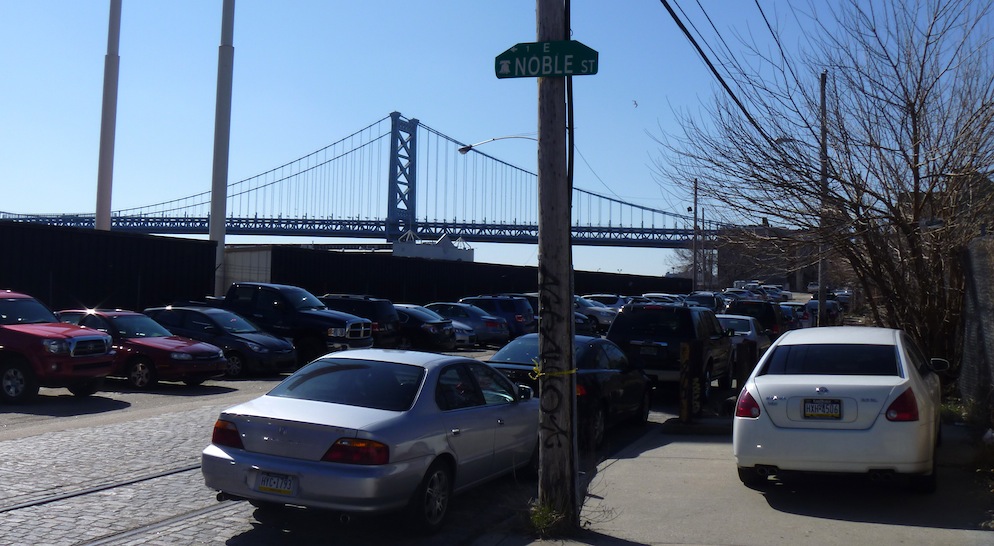
One thing that did catch my eye was in the HSP collection of Philadelphia City Directories. The 1833 directory lists a Lewis Brooks, Blacksmith, at 54 Noble St. His name had been spelled Brooke in 1825. He does not appear in the 1835 directory. The picture above documents my pilgrimage to the intersection of Noble and Front Streets, located in the Northern Liberties section of Philadelphia, on the Delaware River side of I-95, just around the corner from the Spring Garden station on the Market-Frankford line. The Ben Franklin Bridge spans the distant skyline. The street sign with an arrow pointing left indicates that the present-day numbering begins at Front Street. (I-95 obliterated whatever portion of Noble may have once extended to the right.) I imagine that back in 1833 a low street number like 54 would have been located nearby.
Of all the theories I've considered about what the L.W. may have stood for in John L. W. Brooks, the simplest is that it stands for Lewis, especially if one were to emphasize the two syllables in pronouncing the name. The 1820 census for Northern Liberties has a George Brooks, which would fit the traditional naming pattern for John(Lewis)'s oldest son. On the other hand, the maternal grandfather was George, and he may have been the namesake. It isn't much to go on, but that's all I have for now. At any rate, the cobblestones/bricks make it easy to imagine this section of Front Street back around 1830.